

The true purpose of a Consultant Interview

Facing the interview panelA consultant medical interview is likely to be a pivotal point in your life.  Your performance on the day is likely to define your career for years to come.  The interview which you face is the culmination of your many years of dedicated development.  Quality of performance on the day can be directly related to quality of preparation.  With so much at stake it is therefore essential to undertake this task as effectively as possible.

At Oxford Medical Training, we have specialised in Consultant Interview preparation since 2004 and understand the challenge ahead.  Our experience in supporting thousands of doctors has led us to develop both the medical interview skills courses which we run regularly across the UK and this comprehensive guide book.  The structure which we use is designed to help you perform at your very best in terms of both style and substance.

Regardless of whether you are working on a time scale of days, weeks or months, it helps to consider your preparation as a project.  Any well-run project begins with the explicit definition of aims and purpose.

From our experience, we realise that there are a few common misconceptions of what is going on and the process which will be undertaken.  Many of the delegates who attend our Consultant Interview courses have the mindset that they are about to undergo some form of pass/fail test.  They expect that they are about to face an examination of their clinical skills and their knowledge of the structures of the NHS.  Success, however, is more likely to be achieved through better understanding of the process which will be used and the reasons for this.

For any job application process, regardless of profession, there are three obvious sets of stakeholders.  Each set has their own complementary objectives.

Objectives of stakeholders to an interview process:

  • The organisation which wants to fill its vacancy with the most suitable candidate available.
  • The applicants who each want to secure the position for themselves.
  • The interviewers who want to establish the relative suitability of each candidate.

We will use the term ‘organisation’ in broad terms here to represent the body which is undertaking the recruitment: Trust, Health Board, hospital, department, etc.

If you are successful in securing an interview then you will generally be considered to have demonstrated you have the technical/clinical skills and abilities required to fulfill the role.  We will look at this further when we describe the selection process which is utlilised by organisations for recruitment to a Consultant vacancy.  The same is true for all the other doctors who reach this stage of the process.  A Certificate of Completion of Training (CCT) or equivalent and inclusion on the Specialist Register of the General Medical Council should count as proof of your skills.  In other words, you have already passed the test!  So, the interview is not about establishing your clinical credentials.

Neither is it a test of your knowledge of which of the numerous organisations which make up the NHS are responsible for what task or to name the key reports which have been published on particular topics.  If it were, then the organisation could save themselves a lot of time by giving you a multiple-choice questionnaire or some other written exam.  Being able to demonstrate a working knowledge of the challenges and your ability to function within the system are definitely relevant.  This is, however, quite different from being able to recount raw facts.

Tough interview questionWhen we are job applicants, we should ideally be aligned to the organisation’s objectives.  In this case they are unlikely to be simply looking for the most technically brilliant ‘…ologist’.  It is crucial that they avoid appointing the ‘wrong person’ – no matter how clinically brilliant they happen to be.  The role of Consultant goes well beyond your direct investigation, diagnosis and treatment of the single patient who sits before you in your clinic.

Your prospective employers are more likely to be looking for someone who has the attributes to fulfil all aspects of the role which they have in mind.

The organisation will be wanting to appoint the person who is best equipped to meet and exceed the current and future challenges required for the role in every respect.

They are likely to be looking for someone who shares their values with good levels of self-awareness.  The range of attributes which they seek will typically include someone who:

  • works as a team member and provides leadership to others
  • builds relationships with colleagues and teams of all levels
  • is organised and gets things done
  • makes tough decisions in difficult circumstances
  • interacts with the system and makes the most of limited resources
  • supports the development of colleagues and junior doctors
  • is emotionally intelligent and resilient
  • supports others when they are struggling as required

Between the organisation and the applicants sit the interviewers.  They are the human face of the organisation who are tasked with establishing and evaluating the relative suitability of each candidate for the role.  They will seek to fulfil their task by exploring how you work and interact with others in real world scenarios, as well as by probing previous actions and current opinions.  To achieve this, they must conduct their assessments in a fair and consistent manner.  Gaining consistency between individuals on subjective matters is always a challenge.

It goes without saying that your over-riding purpose for putting yourself forward for interview is to secure the post.  So, how do you ensure that your aim for your performance on the day is aligned to the requirements of the organisation?

Many applicants take the approach that the Consultant medical interview is some kind of pass/fail test. It is more helpful to consider it as your opportunity to demonstrate how you can bring added value to the organisation.

This text is an extract from the opening pages of the Oxford Medical Consultant Medical Interview Guide 2018-19

Trouble saying what needs to be said?

Empty speech bubblesThere are times when we need to hear what we need to hear. We need to hear what we are not doing well enough, what we have missed, the problems we have caused others. We need to hear what we need to do more or do less, what to change, what to start and what to stop. We need to hear how we can improve.Though some of us may have well developed levels of self-awareness, none of us can be fully aware of all our short-comings or the impact that we have on other people without help. We all need these things brought to our attention. We need other people to let us know. In many ways, for us to hear what we need to hear, we depend on those who we work with to say what needs to be said.

When should we be saying what needs to be said?

The topic of saying what needs to be said come up in many of our courses. In our Teach the Teacher Courses we explore the need to bring things to the attention of those who are learning from us. In our Essentials of Medical Leadership and Management Courses we discuss initiating/embedding change and dealing with under-performance. During our Advanced Team Communication Skills Course we address the need to bring things to the attention of our leaders and our colleagues. Even on our Medical Interview Skills Courses we work with delegates to make sure they are able to raise controversial subjects and inform a prospective employer of the improvements they need to make to their department or organisation.

Shortcomings in giving feedback or critique, raising challenge or simply bringing things to the attention of others in these contexts can have major consequences. People and teams fail to reach their true potential. Safety issues increase, errors multiply and mistakes are not addressed.  Standards slip, inefficiency is accepted and initiatives fail. It has direct relevance to honesty and integrity. It can even be argued that the Duty of Candour starts with the communication between healthcare professionals. If we don’t speak up then we become part of the problems which surround us. These are just a few examples to illustrate why doctors must skilled in saying what needs to be said. Yet there is a problem.

Trouble saying what needs to be said.

Our published research, based self-assessment by over 200 doctors, has identified a shortfall in sharing feedback and challenge.  Significant percentages say they don’t do this enough or even at all. (Please note that the emphasis here is on face to face discussion, rather than annual anonymous feedback via a digital portal). There are likely to be numerous reasons for this.

We all know it can feel awkward and uncomfortable when we receive criticism or when someone disagrees with us or challenges us. So this may inhibit our willingness to speak up. The medical professions also have a long established culture of hierarchy. So this may make people feel it’s not their place to say something. Bullying is all too often allowed to persist through lack of challenge.  The perception of bullying and team friction can be the result of clumsy critique or challenge. In addition, many doctors have not learned how to speak up and challenge their leaders, peers or learners. They don’t know how to say what needs to be said in a way that it will be heard in a constructive manner.

So what needs to change?

Examples of poor quality critique are abundant in our entertainment media. Alan Sugar and Gordon Ramsey have prospered through barking insults and put-downs. On the X-Factor and other talent shows the judges are often heard telling someone, “You need to take it to the next level,” or “You’re not very likeable.” What can the contestants do with feedback like that? There are parallels here with the reviews which some doctors place for our services on the independent TrustPilot website. We genuinely want to know what we are doing well and what we should improve. Yet a comment along the lines of “Great course full of useful resources and information. I would not hesitate to recommend to a colleague” being followed by an award of 4 stars out of 5 can only ever leave us wondering if we somehow fell short and how we could ever get that 5th star.

The receiver needs to clearly hear what it is that they needs to address so we must communicate this clearly and constructively.

How clearly are you saying what needs to be said? Are you and your colleagues hearing what needs to be heard?

Stephen McGuire – Head of Development

Is reflective practice really a risky business?

Evidence stickerThe tragic case of little Jack Adcock, which culminated in Dr Bawa-Garba being found guilty of manslaughter through gross negligence, has thrown the spotlight on reflective writing.

I’ve always been a strong advocate of the practice. It is the focus of my previous blog posts Detach or connect – a medical dilemma? and A prescription for being a better doctor. There are multiple benefits, including exploration of significant incidents and personal learning. It can also play a major part in developing patient connection with emotional control, as opposed to practicing with disconnection, and in developing sustainable resilience. Until recently, a large proportion of doctors who we explored this approach with on our courses found reflective practice very useful. There have always been some who resisted the idea. Often struggled to get past a dislike for the seemingly endless need for reflective statements from training programmes and appraisals which were then never properly utilised.  Dr Bawa-Garba’s conviction has now introduced an additional complication: anxiety.

Should doctors be concerned?

There is a commonly held belief that Dr Bawa-Garda’s reflective writings were a key element of her conviction. Yet this doesn’t stand up to scrutiny. To quote from the General Medical Council’s case factsheet:

The Medical Protection Society (MPS), which represented Dr Bawa-Garba at her criminal trial, has made it clear that the doctor’s reflective notes were not part of the evidence before the court and jury.

Modern-day doctors adhere to the idea of practicing evidence-based medicine. This should extend well beyond clinical diagnosis and treatment. An evidence based attitude should extend to to all aspects of practice. So it’s important to pay attention to the facts of the case, rather than hearsay and prevailing opinion.

What is correct, and always has been, is that reflective writings could be used as part of a legal case against a doctor against a doctor. There is no statutory restriction in place. But there never has been. Is that fair?

We have to protect ourselves from a mindset that doctors can do no wrong. Although Dr Harold Shipman is undoubtedly an extreme case he is worth a mention. If we know a doctor can genuinely be guilty of the premeditated mass murder of patients, then it is not difficult to imagine that there is a sliding scale on which, somewhere along the line, there could be examples where manslaughter through gross negligence would be a fair and reasonable conclusion. The public deserves to have confidence in their doctors and no-one can ever be above the law. Any successful criminal prosecution depends upon all relevant evidence being presented and considered. The emphasis has to be on the word ‘all‘. If a doctor’s personal written reflections were to be used in court – and they weren’t in the Bawa-Garba case – then they would constitute only a part of the evidence. There would have to be sufficient corroborating evidence to indicate any guilt.

Consider this: if reflections could be used to support a prosecution then they could also be used to support a defence case. Would there be equal levels of panic used if a doctor wanted to utilise their reflective diary to help evidence their innocence?

An example of defensive practice?

It could be argued that active avoidance of reflective writing has a parallel to the concept of defensive practice. The focus has shifted from what is in the best interests of all concerned to the avoidance of litigation. Unnecessary tests, appointments, referrals and treatment processes for the sole purpose of covering the clinician’s back cost the NHS heavily. The costs to the service are both financial and in terms of efficiency. Ultimately the wider service to patients is compromised. There is also a world of difference between a clinical record which has been written to genuinely communicate the patient’s story and one which is intended as proof and justification in case of complaint. Is there any difference between these self-serving behaviours and making a conscious decision to opt out of a worthwhile self-development activity in the remote chance it could play a part in some undefined litigation?

Simple steps for genuine reflective practice.

Without doubt, the conversation about helping doctors find a way to reflect without fear is a positive one. At the same time, it is clear that many have never actually been taught how to conduct a reflective writing exercise for ‘right’ reasons. Please note: the following description is of reflective writing for your personal benefit, rather than for an appraisal submission.

To be successful, you must be willing to genuinely explore your experiences, thoughts and feelings along with your perception of the experiences, thought and feelings of anyone else involved.  Give yourself the time and space for the following:

  • Set a timer for 20 minutes
  • Using pen and paper, or keyboard, write about your experiences over the past week – or the event in question
  • Punctation, grammar, spelling, legibility etc. are irrelevant for this exercise
  • Write only for yourself
  • Go wherever your mind takes you with curiosity and without judgement – and keep writing, no matter what comes into your head
  • When the time is up, throw away the paper or close your digital document without saving

The final point here is nothing to do with the concerns arising from Bawa-Garba case. This is the long established process advocated by James Pennebaker, a leading author on the topic of reflective writing. It is consistent with the original intention: to externalise the information from yourself without fear of repercussion. Refelctive writing slows the mind, creates focus and enables stepping out of the experience to gain perspective.

However, there are other effective methods beyond reflective writing. A coaching-style conversation with a trusted  and skilled mentor is one valuable alternative. Speaking can be just as beneficial as writing and a good mentor could help you explore aspects of which you would otherwise be unaware. We will therefore be increasing the focus on the skills required to facilitate such reflection going forward within our Advanced Teach the Teacher: Mentoring Skills for Doctors.

Stephen McGuire – Head of Development

One simple action to solve the NHS problems?

NHS birthday badgeOn 5th July 1948 the NHS was born. That means in a couple of months this grand old lady will be 70 years old. At an age when most people would be retired and enjoying life at a relaxed pace she is having to work harder and harder than ever before.  More and more is expected from more and more people with restricted resources. She is definitely experiencing some health problems of her very own. It all makes you wonder:

What is the life expectancy of an NHS?

Although no-one knows the answer to this question, many commentators openly speculate. But no-one has ever had a patient like this and certainly not one with these symptoms – or have they?

Let’s go back to the start.  The NHS had a very difficult birth. Though it may be surprising to hear, not every doctor was on her side and would have preferred to ‘let nature take its course’. Dr Alfred Cox, a former Medical Secretary of the BMA, has gained a degree of historical notoriety from his assertion in 1946 that the plan to develop the NHS was “like the first step, and a big one, towards National Socialism as practiced in Germany.” He went on to liken Nye Bevan, who was championing the cause, to a “medical fuhrer” who would “strike down doctors’ cherished professional independence.” If the NHS is often treated like a political football in the present day then it is apparent that this is not a new phenomena.

Much of the current woes arise from the challenges in financing the service. Again this is nothing new. As far back as 1951, with the NHS struggling past its infancy, Prime Minister Clement Atlee proposed the introduction of prescription charges to address the monetary problems. Although this led directly to the collapse of his Government, these charges came into effect the following year. So, as well as being a political football, the NHS has been in financial troubles throughout her entire life.

What’s the simple answer?

If only there was one.  Publicly funded healthcare is incredibly complex. There are multiple challenges. Unfortunately, when faced with such complexity any small action can appear futile or simplistic and we become hopeless. It’s easy to get trapped in an increasingly negative downward spiral.

Much of the time, the debate around finding a solution is focused on financing.  We all want the best care we can receive but how much are we as a society and individuals prepared to give up to fund the NHS? That can lead to a 2-dimensional debate. It helps to balance this with a third dimension – controlling costs. Discussions on controlling costs can easily be lost in accusations of simplistic cost-cutting, being unrealistic or unfair. Yet we are regularly confronted with tangible examples.

Marginal gains

The most recent edition of the BMJ (361:127-168 No 8151) leads with the cover headline, “Emollients for childhood eczema: money down the drain?” which questions the benefits of emollient bath additives. Relevance of continued provision of this treatment is now being hotly debated – expect a strong counter argument by the pharmaceutical suppliers.  But even if a proportion of the £23.1 million being spent on its supply can be saved without any impact then this would appear to be a small step in the right direction.  The idea that “there is no such thing as an insignificant improvement” leads to the concept of the aggregation of marginal gains.

There are others. Lord Carter’s 2016 review into ‘unwarranted variations’ made the bold claim that £5bn could be saved in England alone by addressing long standing poor practice in relation to running costs, absence, infection rates and supplier costs. Little surprise then than current focus within the NHS includes staff well-being and sepsis. Further savings may be possible by really looking into the subject of defensive practice with the related unnecessary investigations and appointments.

Not that any of this is easy. For example, a common point of discussion during our Advanced Patient Communication Skills Course is how to deal with the demanding patient.  You will be familiar with constant pressures for procedures, anti-depressants, antibiotics or an equivalent from your personal discipline. GPs and dermatologists are likely to face similar pressures from parents who fear what reaction will occur from ceasing emollient bath additives.  They may well perceive it as a cut in the level of care they are receiving. Education is an essential part of any change.

The problem with the marginal gains idea

Every little instance of waste being halted contributes to the aggregation of marginal gains. Will it be enough to save the NHS? Probably not. It’s easy to imagine the NHS always existed. Yet she’s only 70 years old. And just like any old lady that we love, it’s hard to imagine here no longer being with us. But its possible this that could turn out to be another example of the circle of life?

The ultimate end point for the accumulation of marginal gains is easier to predict.  You eventually reach the peak of the mountain with nowhere to go. So it can only ever be a part of the answer. Will we ever be able to make the transformational leap to a different mountain and a new system? Possibly. But until we know what that mountain looks like, there are many marginal gains for us to be getting on with.

Stephen McGuire – Head of Development

To lecture, or not to lecture?

Lecture to one personThe subject of lecturing and presenting is one which we discuss regularly on our Teach the Teacher Course of Doctors. Without doubt, a well planned, well delivered lecture by a great speaker on an appropriate subject can be very, very effective. It is a good option where audience numbers are large and the focus is on knowledge. You can guarantee your explanations, ideas and messages have been made available to each and every learner in a consistent manner. Many medical schools have large cohorts of students at each stage level of development. Many conferences are staged at large venues with lectern, screen and microphone. As a consequence, the lecture has become a default style of teaching for doctors around the globe. But is it always the best option? To lecture, or not to lecture?

That is the question

On our course, we begin by exploring the theory of adult learning. Although we all have our individual preferences, there are some universal truths. One of these truths is that our ability to pay attention, grasp concepts, interpret information and then commit them to memory is directly related to stimulation of our senses and intellect. Good lectures certainly stimulate our aural and visual senses. They can also be designed to stimulate intellect. However such an approach to teaching misses many vital ingredients. As numbers of learners decrease, any sole reliance on lecturing becomes increasingly absurd and misses many opportunities. In addition, your ability to practice as a doctor goes well beyond knowledge alone.

Imagine talking with a group of friends

Can you really develop skills such as manual dexterity by universally addressing the crowd? If you were trying to explain something to them would you present for 45 minutes in the manner of a television broadcast, then offer them 10 minutes for questions – or would you do something else? Taken to the extreme, if you were aiming to help just one person learn something, would you deliver a lecture?

In addition to being exposed to theory, the vast majority of learners relish the opportunity to discover things for themselves. As well as learning from observing others they need to experiment and practice. Our attention levels are boosted through engaging with other people and through movement. In short, we all benefit from interactive, experiential approaches to learning.

Versatility starts with mindset

When tasked with helping a group of people learn about something, many of the words which come to mind drive us in the direction of delivering a broadcast style lecture. “My presentation”, “I’m doing a talk”, “I’ve been asked to speak about…” are just a few of the examples. A simple shift is to take the view that “I am running a teaching session”, or, even better, “I’m helping this group of people to learn about…” Connecting that paradigm with a little creativity opens the window to a very different experience for the learners.

So, although a lecture has its time and place, it is only one of the methods that you can utilise to help enable others.

Stephen McGuire – Head of Development

Team interaction challenges for medical leadership

Weak chainconnectionsFocus on medical leadership has been increasing in recent years. The benefits are well documented. It is well accepted that good leadership brings mutual benefits for patients, organisations and individual doctors. However the concept of leadership varies to some extent between different authors. I’d summarise it as ‘getting things done through other people’. That’s a simple memorable statement which could easily be accused of disguising the complexity of the challenge. The overall intention of medical leadership is fairly easy to define: effective, efficient and compassionate patient care. That’s the end result. The big question is, ‘how to achieve this?’
The direction of leadership development

Much leadership discussion and development is directed toward the human interaction between leader and follower. This idea would seem to sit very comfortably with the concept of ‘getting things done through other people’. However, the concept of leader and individual follower misses the point that the follower will, more often than not, have to work with others to achieve the desired outcome. Modern healthcare is delivered via groups of people, rather than by individuals. A single patient is likely to be cared for by a consultant plus ST and Foundation doctors from the same specialty. They may well require care of doctors from more than one specialty. They have their own GP. Locums cover holidays and absences. Nurses and a broad range of other health or social care specialists could be involved. For the patient’s care to be efficient and effective these various professionals must act together as one functional team.

The problem

Groups of people do not automatically form coherent teams. It requires dedicated focus. As such, this is a matter for medical leadership. My peer reviewed research into the team interaction behaviours of over 200 doctors has now been published in BMJ Leader. It identifies a number of issues. The self-assessment of the participating doctors indicates:

  • 45% are not challenging or giving feedback to their colleagues
  • 42% are not proactively seeking honest feedback
  • 40% are not discussing progress toward goals
  • 39% are not discussing the support they require to fulfill their role
  • There are also significant mismatches in perception. Attitudes of “I am committed but others are not” and “I am willing to help others but they are not willing to help me” are also apparent.

There must be questions here about the Duty of Candour. The suggestion is that doctors are seeing things which are not good enough, even wrong, yet not discussing this with their colleagues. At what point does the Duty of Candour actually begin? The shortfall’s in team interaction must have direct on the delivery of patient care, efficiency of organisations and the day to day experience of individual doctors.

 The challenge

Efficient, effective, compassionate patient care is the headline goal. To achieve this, leaders must focus on teams as much as they focus on individuals. Great teams don’t just happen. They have to be consciously nurtured and maintained.  Leadership development must therefore go beyond the ability to influence and support individual followers. Great leaders take proactive steps to gain insight into the complexities of team interaction and communication skills.

What steps are you taking to improve your team leadership?

Stephen McGuire – Head of Development

New Online Medical Leadership & Management Course

Leadership and management is of increasing importance for today’s doctors.  At the same time, online training is increasingly popular.  So we’re delighted to introduce our new Online Medical Leadership & Management Course which is accredited for 3 CPD points.  The course is delivered in 10 short modules which you can access anywhere that you have an internet connection. Here’s a sneak preview of the 2 minute introduction video.


Click here for more details.


Patients come from all sections of society

Colourful autism awareness imagePatients come from all sections of our society.  They present from all across our diverse demographic, multi-cultural population and beyond. Each brings their own experiences, opinions, attitudes and abilities.  A large proportion of patients are experiencing stress in one form or another.  Whether the stress is of a physical or emotional nature it is very likely to impact on their usual daily behaviour.  Where some have a heightened need for emotional connection, others want left alone.  Some become irritable, some aggressive to offer just a few examples.  The potential reactions and related communication challenges they create can seem almost endless.

Finding solutions

Many doctors come to our Advanced Patient Communication Skills Courses seeking simple solutions.  To find these solutions, we spend time exploring the drivers of human behaviour.  The best doctors recognise the importance of making appropriate connection with patients and family members.  They achieve this by adapting their approach with flexibility.  However, a good clinician recognises the need to avoid simplistic approaches.  It helps to be mindful of the fundamental psychological dilemma: we are all the same, yet we are all unique.

Specific challenges

But what about the cases where making such connection presents specific challenges?  One example could be adults who have hearing loss.  This has been the subject of recent discussion in the BMJ.  Another is with patients or their family members who are on the autistic spectrum.  Autism is a lifelong developmental condition that affects the way a person communicates, interacts and processes information. We asked Charlene Tait, Director of Autism Practice and Research at Scottish Autism, for some advice.  Charlene gave us the following recommendations which have been developed through working with a variety of clinicians:

  • Offer the opportunity for people to undertake a series of familiarisation visits rather than expect them to comply with examinations on the first visit
  • Post some visual information on your website if you have one
    • photographs or a short video showing what people might expect to happen when they come for an appointment
  • Ask them or find out from the person supporting them how best to communicate
  • Allow additional time for the appointment
  • Reduce your use of social chit chat
  • Provide a narrative e.g. I am going to… Now I will… ,
    • this avoids unwanted surprises and is especially important if you are intruding on personal space, touching or adjusting the environment e.g. dimming or increasing light; introducing medical devices or equipment
  • Improve your understanding of autism by visiting scottishautism.org
  • Be kind

Simple adjustments can bring significant benefits for both patient and clinician.  Thanks for the practical advice Charlene.

Stephen McGuire

Head of Development

Leader, Follower or Something Else?

Leadership is often hailed as the solution to the countless challenges which healthcare faces.  It is unquestionably important.  In their Leadership and management standards for medical professionals, the Faculty of Medical Leadership and Management emphasise the benefits it can bring for patients, doctors and individual doctors alike.  As a result, many doctors proactively seek out CPD training on the subject.  They want to lead well and to get things done.  Gaining a Certificate of Completion of Training (CCT) will also typically expect evidence of participation in leadership and management courses.  Is there a risk, however, that such focus is too one-dimensional?

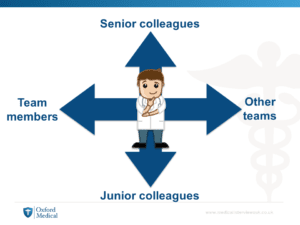
Four dimensions to consider

Diagram of four groups to communicate with

  • Leadership
  • Followership
  • Team membership
  • Interdependence between teams.

Unless you are the owner of your practice or leader of organisation then you are also a follower.  You follow your organisation’s more senior leaders.  You will also be a team member – potentially of a leadership team – and the team you lead must work in conjunction with other teams to deliver your services.

Good followers are much more than passive individuals who follow orders without question.  They keep their leaders informed, proactively seek clarity, constructively challenge at the appropriate time and propose ideas.  They then use disciplined initiative, following the direction of their leaders as they fulfill their role and lead others.  The best leaders have a firm grasp on what makes a good follower as they are typically good followers themselves.  Great leaders forge strong communication channels with their own senior colleagues to help their organisation move forward in a unified direction.  They know the challenges of being a follower and use this to support those they seek to lead.

Truly unified direction within a large organisation can only be achieved through leadership teams.  Great team players communicate effectively with each other, share clarity of purpose, processes, roles and responsibilities.  The best leaders work with their peers to achieve these conditions.  As they understand team dynamics they create the culture where they foster great teamwork between the people that they lead.

In this modern era, where multi-morbidity is increasingly common, coordinated health and social care is dependent on a plethora of multi-disciplinary and specialty teams.  The route to effective and efficient provision of care is through quality communication and interdependence between these teams.  Great leaders enable this as they, once again, have a good grasp on the need for these conditions and have developed the skills to interact with other teams.

 Support from above, below and alongside

So an irony of being great leaders is that we have to be great followers, great team members and great connectors with other teams.  Great leaders recognise the problems which arise through isolation or any shortfalls in each of these four dimensions.  Everyone, from top to bottom and across an organisation needs support from above, below and alongside.  In truly great organsations each and every member strives to achieve this.  Medical leadership and management courses must therefore be designed and delivered with awareness of these challenges mind.  And, in addition to courses directly labelled for leadership and management, great leaders should seek to develop strong team communication skills.

What steps are you taking to become a great leader?

Stephen McGuire

Head of Development

Can investigations do more harm than good?

Sherlock homes investigatingThe series events which have led to Dr Hadiza Bawa-Garba being struck off the GMC register after being found guilty of manslaughter have brought the management of healthcare errors into the spotlight.  In response, Jeremy Hunt emphasised “If we are going to keep patients safe then we have to make sure that doctors are able to learn from mistakes.”  It has to be accepted that mistakes are inevitable in complex systems.  As the old saying goes, “To err is human.”  This does not mean that we should accept everything that goes wrong.  Incidents and near misses should always be thoroughly reviewed and it is essential to differentiate between the honest mistake and true negligence.  But how to ensure that investigations come to the right conclusions?  These are matters which we discuss during our Practical Leadership & management Course of Doctors.

Reviewing the review process

In October 2015 the Care Quality Commission reported on their investigation into reviews being conducted within healthcare stated, ‘In our review of the quality of investigations into serious incidents involving patient care in acute hospitals….. we conclude that while investigation of serious incidents is often seen as one of the most important elements of the patient safety process, this can be counterproductive if not done well’.

They went on to emphasise the purpose of investigations in such circumstances: ‘to identify significant opportunities for learning to reduce or eliminate the risk of the same thing happening again.’ before highlighting the following points:

‘We have observed a high number of investigations that:

  • show a lack of skill and expertise in the methodology used.
  • do not identify the underlying systems issues that led to the incident; or that leave the reader with unanswered questions.
  • There was also limited evidence that patients and families were engaged in the process, or that clinical and other staff were sufficiently involved’.

In the same year the UK Government Select Committee Report stated: ‘The focus of investigations into ‘never events’ was ‘preoccupied with blame or avoiding financial accountability.’

Further pitfalls

Though conducting a review sounds fairly straightforward, doing it well takes dedicated effort and a degree of skill.

One potential pitfall is to confuse correlation with cause and effect.  Just because a relationship exists between two factors does not necessarily mean that one is the cause of the other.  For examples: when the Czar found out that the most disease-ridden city of the empire was also the city with the highest number of doctors, he ordered the execution of all doctors in the state.  A logical conclusion and course of action?

At the other end of the scale the writer Malcolm Gladwell explores the idea in a number of his books that too often we find ourselves drowning in facts at the expense of true understanding.  Being able to list off the events which led up to a past event does not automatically mean that you understand what actually caused the event and how to either avoid or repeat a similar occurrence.

Further difficulties arise from the phenomenon of creeping determinism.  It can be all too easy to examine an event, establish the trail of incidents which led up to it and to conclude: “How did they not see that coming?” or “Why did they not do something about it before it got to this stage?”  This type of thinking is of response is often observed in reaction to everything from terrorist attacks and the outbreak of wars, all the way down to team performances where football pundits assess why your favourite football team lost a goal.

The way forward

The same processes and principles which guide quality investigation into problematic incidents have equal relevance to situations where things have gone well.  Why were we successful?  What did we do differently?  This helps to reinforce the positives rather than simply focus on the negative.

For unwelcome events, the differences between negligence, incompetence and human error must be understood and the true reasons identified.

  • True negligence is unacceptable and should be treated as such.
  • A conclusion of incompetence leads to numerous further questions before the correct course of action is identified.  Were they consciously or unconsciously incompetent?  Why was the incompetent person put in this position?  Could the series of events been reasonably predicted – given everything else that was taking place at the time?
  • Where the cause is human error the next question has to be :”Why was human error possible?”  That’s where the true issues are likely lie.  And to quote the full version of the the 18th Century poet, Alexander Pope, “To err is human, To forgive, divine.”  This may be easier said than done than the patient or their family who have suffered harm as a result which puts understandable pressure to find answers.

The CQC’s report concluded, ‘it is important that providers develop expertise and invest in the tools needed to properly investigate, so that the right lessons are learned and shared.’  What steps are you taking to improve your skills in this area?

Stephen McGuire – Head of Development