
In this recorded webinar, Doctors Subashini Wickramathilake, Himani Murdeshwar and Alex Rouse share their varied foundation years experiences. This is a must watch for anyone who is at this pivotal stage of their career or involved in supporting doctors during their foundation years in any way.
Category: Uncategorised
Top 5 for Medical Staff Training & Development

I’m delighted to say that Oxford Medical Training has been included in Healthcare Business Review’s annual listing of the top five UK companies that are at the forefront of providing Medical Staff Training and Development Services. We are on the cover of the September European and UK edition of their publication along with a main feature inside.
Our “Excellent” rating for service on TrustPilot played a major part in the judges decision. So, I’d like to say a big thank you to all of our course delegates and learners who posted reviews as these lead to our overall TrustPilot score.
And, of course, a huge thankyou to the Oxford Medical team, to our Faculty of Tutors and to the team at Perceptive who develop our website. This wouldn’t have been possible without your contributions!
Stephen McGuire – Managing Director
What I wish I’d known for my foundation years | part 1
Here are some thoughts from Dr Subashini Wickramathilake, winner of our recent blog-post competition:

You may have just left behind your childhood home, your inner circle of friends, the corner shop whose owner knows your first name or the adopted city that you’ve called home for the last five years of med school. You are becoming the shiniest new part of the intricate machinery that is the NHS. Just as you have to adapt to this new challenge, so does everyone else, who have spent the last few years or decades working at the hospital, have to adapt to you. You, a newly minted junior doctor, taking on the highest duty of all – responsible for the physical and mental health of fellow humans, who trust you with their life. Take a breath, congratulate yourself on getting into the program and learn to be comfortable with the uncomfortable.
You don’t need to know everything to become a reliable doctor. You do need to have a curiosity to learn and the courage to accept feedback. Feedback given in a busy ward with very ill patients and irate relatives may sting at times. Just breathe. Remind yourself to never take it personally, do not let the words of others undermine what you have achieved. Remember, a sailor that does not face rough seas will never learn to sail. Don’t underestimate how much you will learn from your most challenging night shift, even if you feel shattered by the end of that shift. However, please do reach out for help when you feel overwhelmed – this isn’t weakness. Looking out for your own mental, emotional and physical wellbeing is your most important priority in those two years, especially your first year. And don’t be afraid to speak up if you are treated unfairly. Whether it is your educational or clinical supervisor, a senior Registrar, the nurse in charge or the wellbeing team at your hospital, help is at hand. Everyone knows this is a strange new environment for you and most people are more understanding than you think. Don’t be afraid to ask when in doubt, just pick your moment well! A good tip is to first state what you already know, then ask what you don’t.
For your department orientation, you can expect anything from a detailed induction where you will have a clear idea on your job role and who to ask for help to a mere half hour introduction when the Registrar will ask you to complete discharge summaries as they run off to their morning commitments. Take a breath and focus on the task at hand. Remember that these departments were running efficiently before you showed up and they will continue to do so long after you have left. Learning in the NHS will come in bits and pieces, don’t expect the linear learning you experienced in med school. There won’t be daily lesson plans, flowcharts, a whiteboard or note taking. The ward rounds will not always be structured, your consultants will be pulled in many different directions, you may have to chase them for clear treatment plans. Discover your voice and use it wisely. Remember, every day, millions of people are being tended to at their most vulnerable, you are now a part of that. No role is too small, take pride even in the most mundane tasks. You will learn as you go. Don’t underestimate your ability to grow and adapt. Be kind to yourself and others, make time for people that uplift you and be positive – you’ve got this! Rome wasn’t built in a day, but they were laying bricks every day.
Dr Subashini Wickramathilake
What I wish I’d known for my foundation years | part 2
Here are some thoughts from Dr Himani Murdeshwar, runner up in our recent blog-post competition:

Brimming with aspirations and nervous excitement, the cohort of young graduates made their way to the Induction. I was one among them and still have a vivid recollection of what was only the prelude to the symphony that followed.
We were primed with all the knowledge we would need to begin work, told where to look for support, and informed what we could and couldn’t do in our new role as foundation doctors. Yet, on the first day of our first rotation we continued to be haunted by the imposter syndrome. “Did we really know enough to make decisions for patients?” It all felt so new, often overwhelming. “Did I do it the right way?” “Should I have prescribed that?” “Did I answer the patient’s question correctly?”
Year after year, a batch of hopefuls embarks on the formative years of their medical careers. They come to the hospital each day, taking a leap of faith, pushing their abilities to their limits. And as you, my dear readers join the ranks, let me reassure you that it is perfectly normal to have mixed feelings. I would urge you to see the foundation programme as a rite of passage and to progress through it, with a view to discover and learn more about yourself, than anything else.
Life presents us opportunities to reflect on our lived experiences and more often than not, most would want to do things differently, if given another chance. Therefore I take this opportunity to share my thoughts on “What I wish I’d known for my foundation years,” hoping to relive that period vicariously through you all.
“Help will always be given at Hogwarts to those who ask for it.” Professor Albus Dumbledore’s words are as true for those starting at Hogwarts, as they are for our new foundation year doctors. Do not hesitate or feel guilty about admitting to your inability to do something. Ask for supervision while doing a procedure or for a demonstration of how to conduct a difficult conversation. Make sure to debrief at the end of the exercise to optimize your learnings from the experience.Honesty, diligence and prompt escalation in challenging situations will help you win other’s trust as a safe junior doctor and stand you in good stead.
Every new rotation is your chance to wipe your slate clean and explore life in a new specialty. Take this opportunity to develop your long-term goal and work in that direction. Maintaining a logbook for surgeries you were involved in, updating your e-portfolio, undertaking audit and QI work are instrumental in demonstrating your commitment to a specialty.
With time, build your understanding of the roles of other team members, seeing them as more than just cogs in the wheel. Building rapport with the nurses, health care assistants and dieticians will develop your ability to function as an effective team member and in due course team leader.
The foundation programme can prove to be nothing short of a roller coaster ride. Certain rotations will be action packed and exciting while others might seem rather humdrum. It is for such days, that you must have a support system to rely on- friends, flatmates or family. Be sure to book your annual leave in time and plan any necessary swaps in advance to make the most of it.
The foundation years are an enriching phase that moulds us into better professionals and multi-faceted individuals ready for any curveball life throws at us. And as you take your first step in this direction, all I’d like to say is, “Believe in yourself!”
All the best!
Dr Himani Murdeshwar
Results: What would you say to a new FY1?

Back in May, we launched a competition, asking doctors to volunteer a blog post with the title, “What I wish I’d know for my foundation years.” The idea is to support the latest cohort of foundation year doctors who have arrived in the NHS at the start of August.
We can now reveal the winners of the competition as:
- Winner: Subashini Wickramathilake
- Runner-up: Himani Murdeshwar
Both Subashini and Himani have now received their choices from our range of online courses as the first element of their prizes. We will be publishing their winning blog-posts over the next week or so on our News & Insights webpage and will also include them in our next Insights newsletter.
Our two winners also joined both Alex Rouse from our Faculty of Tutors and myself in discussion on a short webinar which will be posted on our News & Insights webpage in the near future.
The entry which made us smile…
We’d like to give a special mention to Rubab Batool, who provided us with the shortest entry to the competition:
“It’s okay to feel overwhelmed. It’s okay to feel absolutely clueless , it’s okay to make mistakes, it’s okay to feel as if you don’t know anything. It’s natural and it’s common. We all felt this way and most likely you will feel this way. Remember to ask your seniors about their favourite and cleanest toilets (apparently that is another secret ).”
Some wise words – and some which made us smile there! As a result, we decided to award Rubab with the 3rd prize which was one course from our online range.
Please share this page with anyone who you know who is starting their foundation years. The webinar is free and everyone is welcome.
Stephen McGuire – Managing Director
Bohdan’s story

There’s no doubt that the normal paths of training to become a doctor can involve some stressful situations. So, if you have any involvement in this training, then it’s essential to be aware of how this can affect the ability to learn. It can have a critical impact on concentration levels and memory process. This may be temporary, but at its worst, can sow the seeds of depression and burnout which are all too prevalent. The best teachers realise that they need to watch out for this and support their learners on a human level where possible. We are all individuals, with our own stories to tell and it pays to make space for these stories to be told. I’ve recently had the sobering experience of corresponding with Bohdan, a final year medical student in Ukraine. (His name has been changed at his request). Here, shared with his permission, is his description of his recent experiences.
Bohdan’s Experience
“As a student you are mostly focused on studying, learning new things, on exams, tight deadlines and rising to the challenges.
But stress changes your priorities, your goals, your mental health, and even physical health.
Just a few days before our new semester started, I was excited to be attending classes in hospitals rather than online as covid cases have declined and most of the students and doctors are vaccinated.
As this is my final year, I was excited to learn new things and wanted to spread my focus beyond the standard curriculum. I was researching the PLAB exam. I was trying to join a research programme and preparing to attend a medical conference. Life was good until some news came that war was coming. At first, I thought it was fake news and continued with my university classes as normal. But it started to make an impact. During every class, I’d start to be distracted. If war starts, then what’s the future going to be like?
The worry grew day by day as it became clearer that war was going to start soon. All the embassies closed. Their staff started leaving the country. So, I decided to book a flight so that I too would leave the country. But then I remembered we are having live classes. I didn’t know what to do.
Then -it seemed suddenly in the end – war started and our teachers had to stop our classes. It was very upsetting for me to see the places I had visited burn. I stressed about friends and their family. Are they safe not? In this whole period, I couldn’t concentrate on my studies as it was very stressful. I felt depressed. I felt helpless.
After a few days, our classes restarted online. One brave doctor took our classes from the war zone – I could literally hear sirens in the class. Sadly, I had left my possessions there – all my clothes, my books and all my notes. Now I can only study from the internet and am trying my best to learn – but my concentration is not that good at the moment.
Not long ago, we were taking classes in hospital and preparing for our future. Now we are just surviving. It is a lot to go through. These stressful events changed my life in every aspect. In the past, I could study for hours. Now I feel exhausted after 1 hour. I’m losing my hair. But I want to be a good doctor. So, I am trying to get back to the track, to increase my knowledge and achieve my goals.”
Reflections
I’d like to thank Bohdan once again for sharing his experiences with us and for giving us permission to share them with you.
Our medical students and registered doctors include people from a broad variety of cultural backgrounds and nationalities.
How well do you know their stories?
Stephen McGuire – Managing Director
Footnote: We have provided Bohdan with free access to our Teach the Teacher Online Course to show our appreciation for allowing us to share his story.
How we responded and adapted to the pandemic
The Leaders Council of Great Britain & Northern Ireland recently interviewed Peter Charlesworth, our Chief Executive at Oxford Medical Training. Here’s their podcast where Peter discusses our experiences over the past two years. He describes the challenges we faced and how we have adapted to support the training requirements of more doctors than ever before.
.
Weighing a pig won’t make it bigger!

You may, or may not, have noticed that the Health and Care Act 2022 finally passed through parliament recently. After a great deal of contentious debate, the mainstream media gave it very little coverage in its final stages. Much of its focus is on paving the way to enable significant reforms to the way the NHS in England functions. At its heart is a shift from using competition between providers to collaboration and integration with other care services to improve quality and efficiency. You may well soon find that you are working more closely with doctors from other trusts, sharing equipment and even team members.
Integrated Care Systems will now use this, in part, to address issues of staff shortages, whether due to short term holiday, absences or long term vacancies. As a result, you will want to be skilled in team communication. You need to be capable of efficiently joining new teams. You also need to effectively welcome other doctors to temporarily join your team if you are going to work together efficiently.
What’s wrong with weighing the pig?
One key aspect of the new legislation is that it creates a duty for the Health Secretary to publish a report on workforce planning at least every 5 years. With staff shortages being one of the biggest issues which the NHS is facing, critics argue that this requirement falls far short of what is needed.
There’s an old saying that “weighing your pig doesn’t make it any heavier.” If you were a farmer, you’d want your livestock to grow big and healthy. That’s what increases their market value and feeds your family well. So, knowing how they are progressing is important. And the obvious thing to do is to weigh them regularly. But weighing them alone is not enough. You need to take action if you want to make a difference. That starts with nourishing them properly. You want to provide a good environment with exercise and intervene by calling the vet if things are going in the wrong direction.
So, simply reporting on numbers of doctors or nurses by age, specialty, grade and ethnicity along with numbers of vacancies will, in itself, only take us so far. Making the badly needed difference requires well considered and well executed action planning. Otherwise, our Health Secretary will be doing the equivalent of just weighing the pig.
What’s going on in your own back yard?
The vast majority of us don’t have any direct influence over the way the Health Secretary goes about his business. So, let’s switch the focus to your own daily activities. How many targets are you aware of that you or your team have? What scores are your organisation comparing against other providers, against local or national averages? How often are you keeping track, ticking boxes or filling in forms, contributing to the collation of these statistics?
Now, here’s the big question. How often are you and your team actually using this information? Are you genuinely utilising them or is their generation a pointless bureaucratic exercise? Our peer reviewed research published in BMJ Leader found that 40% of doctors felt they don’t effectively discuss progress toward goals with their team. Sadly, it appears that many are wasting time weighing the pig rather than taking actions that will make a difference.
Making a difference
On our Practical Leadership and Management Course for Doctors we discuss how to go about making a genuine difference. Yes, making measurements is important. But it has to go hand in hand with clarifying why things are the way that they are and how your performance compares to others. Next, it’s about defining what you want to achieve and why? Before going on to develop clear, allocated and time action plans. Then, it’s about making sure things get done. Making sure everyone is taking the agreed steps, dealing with procrastination and overcoming obstacles.
Often the difference comes when we understand why something matters. Is your team tracking how well you keep to appointment times? Or are you striving to see patients when they are expecting to be seen as you realise they currently have to take a half-day off work for a 10 minute appointment with you?
So, are you simply weighing pigs or are you striving to make a difference?
What would you say to a new FY1?
Our competition entry deadline has now passed. Winners will be announced July 2022.
The latest cohort of foundation year doctors will arrive in the NHS at the start of August.
Take a moment to think back on your experiences since you were in that position. What do you know now that you wish you’d known back then? What advice do you wish you’d been given? What proactive steps could you have taken that would have helped you along the way?
This year, we’re giving you the opportunity to help the latest group of foundation year doctors by sharing your thoughts via our blog post competition. We have some fantastic prizes lined up for the winning entries.
What I wish I’d known for my foundation years
Entering the competition is simple. All you need to do is write out your advice as a blog post to be read by someone starting their foundation years on the entry form.
Your entry should be 400-600 words long and the title is “What I wish I’d know for my foundation years.” Your focus should be on getting the best from the first two years after medical school. To make it easier, you can save a draft version on the entry form, then revisit it to make amendments whenever you want. Entries must be received by end of May 2022, so best to get started sooner than later.
The prizes
- 1st prize – your choice of any 3 online courses*
- 2nd prize – Your choice of any 2 online courses*
- 3rd prize – choice of any online course*
*Make your choice from any of the courses listed on our Online Courses page.
See your blog post published: We will publish the 3 best entries as blog posts on our website, clearly attributed to the winning authors during July 2022.
Participate in our webinar: In addition, we will invite the winning authors to participate as members of the discussion panel on our webinar on the topic at the end of July/start of August 2022. (date to be confirmed).
Terms and Conditions
- This competition is open to all doctors registered with the General Medical Council who work within the the NHS, except employees and contractors of Oxford Medical Training Ltd, their close relatives and anyone otherwise connected with the organisation or judging of this competition.
- There is no entry fee and no purchase is necessary to enter this competition.
- By entering this competition, you agree to be bound by these terms and conditions.
- The winners agree to the use of their name and image in any publicity material and to allow Oxford Medical to publish their work, in perpetuity as a blog post on the News & Insights section of our website. Copyright will remain with the entrant.
- Any personal data relating to the winners or any other entrants will be used solely in accordance with current UK data protection legislation incorporating GDPR, and will not be disclosed to a third party without the entrant’s prior consent.
- Only one entry will be accepted per person. Multiple entries from the same person will lead to disqualification.
- Entries must be submitted using the online entry form. Oxford Medical accepts no responsibility for entries not received for whatever reason.
- You must submit your entry before 08:00 BST on Wednesday 1st June 2022. After this, no further entries to the competition will be permitted.
- Our panel of judges will choose the winners of the first, second and third prizes after reviewing all valid entries.
- Oxford Medical’s decision in respect of the winning entries and all matters to do with the competition is final and no correspondence will be entered into.
- We will notify winners within 28 days of the closing date and provide the prizes in the form of a limited-duration voucher to be used to purchase from the Online Courses page on our website.
- The prizes are as stated and no cash or other alternatives will be offered. The prizes are not transferable. Prizes are subject to availability and we reserve the right to substitute any prize with another of equivalent value without giving notice. Oxford Medical is not responsible for inaccurate prize details supplied to any entrant by any third party connected with this competition.
- The winners’ names will be published on the News & Insights section of our website 28 days after the closing date.
- This competition is being run by Oxford Medical Training Ltd. We reserve the right to cancel or amend the competition and these terms and conditions without notice in the event of a catastrophe, war, civil or military disturbance, act of God or any actual or anticipated breach of any applicable law or regulation or any other event outside of our control. Any changes to the competition will be notified to entrants as soon as possible.
- The competition and these terms and conditions will be governed by English law and any disputes will be subject to the exclusive jurisdiction of the courts of England.
Should you worry about archer syndrome?

Take a look at this picture. What might the archer be thinking about the person in their sights? They’re probably seeing them as being a problem they have to deal with. But it’s pretty obvious to everyone – or at least everyone apart from the archer – that both parties face impending disaster here.
You’d like to think that someone would bring this to their attention. Someone should say something. But who? Does it take a matter of life and death before we speak up? Would we speak up even then? Or would we assume someone else will?
We’ll come back to reconsider this image from a couple of different perspectives shortly. But first, let’s look at some data.
Doctors and feedback
Almost 1,000 doctors have completed a questionnaire which we’ve included as an optional activity in our Medical Leadership & Management Online Course. Here are a couple of charts which illustrate the results we’ve collated in relation to the subject of feedback. It’s important to note that these results are the self-assessment of the participants, rather than the judgement of anyone else.

So, 50% of the doctors who have taken part state that they don’t challenge or give corrective feedback either enough or at all. It’s worth pointing out that the respondents cover a broad spectrum from Foundation Years to Consultants, surgeons, physicians and locums.
And the next chart illustrates that they see this being repeated all around them in their colleagues’ behaviour.
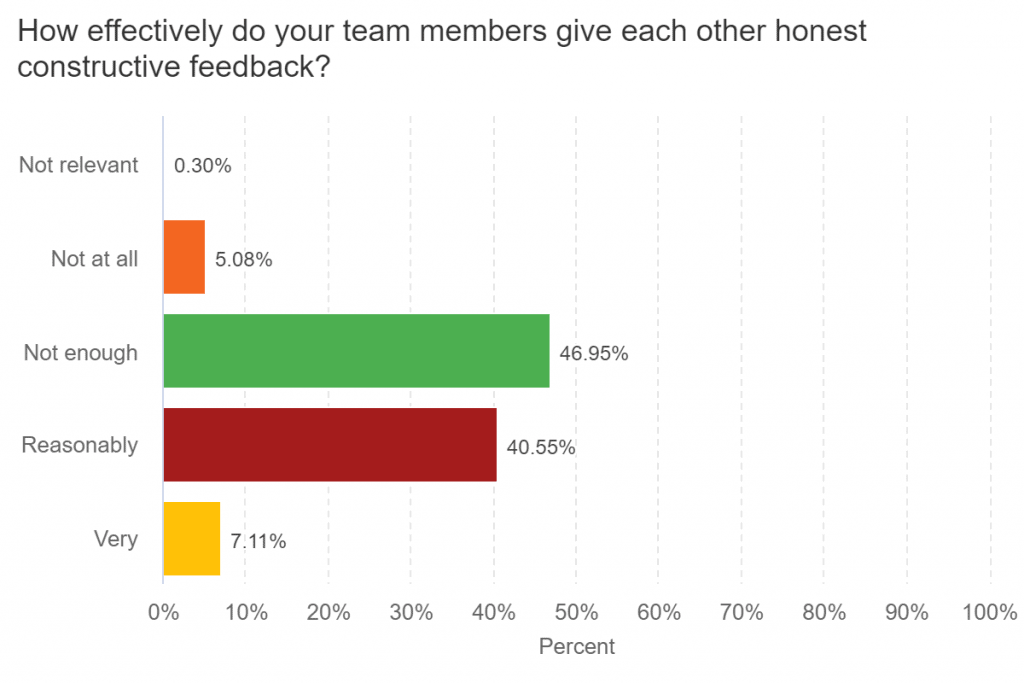
Although there are many reasons why we might hold back from saying what needs to be said in different circumstances, our participating doctors are telling us they believe they should be speaking up more effectively.
So what about archer syndrome?
Now, let’s return to our picture. There may well have been times when you’ve felt like the person in the archer’s sights. You may have had some bad experiences with receiving feedback or challenge where the other person didn’t seem to care about the consequences. Their message was an arrow fired in your direction which caused you pain and possibly lasting damage.
But now consider this. When you see something that isn’t right, do you hold back from speaking up because you worry that it could all go wrong? Do you worry that there will be problematic consequences?
Maybe you worry that the other person will be upset. They might react angrily toward you. Or worse, could someone perceive you to be a bully? Could speaking up result in someone making a complaint about you? Or could you be embarrassed, labelled as an interfering know-it-all or even ostracised? In other words, do you hold back because your don’t want to be like the archer? Do you worry that challenging someone’s actions or behaviour would trigger a disastrous chain of events?
You definitely want to avoid suffering from archer syndrome where you take aim and fire without considering the consequences. Many doctors on our courses confide in us that this is why they avoid giving feedback. They’re afraid it will end badly. But what are the consequences of not speaking up when something needs to be said?
We need a cultural shift
Feedback skills are essential for many areas of modern practice. We explore the subject in our various teamwork, leadership, teaching and mentoring courses. We need a significant cultural shift in the approach to feedback. And not just anonymous, annual, written feedback – which has it’s place – but actually speaking to other people in everyday situations. We need a culture where doctors know what they are doing well, what they are doing which could be problematic and how to improve. This requires freeing doctors from fear of archer syndrome and empowering them to speak up in a constructive manner.
Playing an active part in this cultural shift will in itself requires you to and bring the problem to the attention of others. You’ll need a high standard of feedback skills. It’s never too early, or too late, to work on this area.
Ideally, when giving feedback, our aim has to be to help the other person. We must choose the correct time and place, then send our “arrow” as a constructive message for them to safely receive.
What are you doing to play your part in achieving this cultural shift?
Stephen McGuire – Managing Director
