



Updated 4th November 2025
Completing your application for a training post can be a challenging task. You want to ensure that you stand out from the crowd by presenting the full breadth and depth of the experience that you’ve gained to date. At the simplest level, this means submitting the strongest application you can. For example, you will want to score as many points as possible on the self-assessment for IMT, or to achieve the highest grade indicator when your are uploading your index page for CST. However, it’s essential that you are honest when claiming your points or indicators and follow the guidance correctly.
On this webpage, we provide you with some background, an overview of how our various Teach the Teacher Courses relate to different recruitment processes, followed by a detailed look at each of the most popular programmes and, finally, other points to consider.
Table of contents
- Last minute changes to application criteria?
- Summary table of Teach the Teacher courses and training programmes
- IMT, ACCS and other Physician Higher Specialty Training programmes
- Core Surgical Training portfolio guidance
- Radiology Teaching and Training
- Ophthalmology ST1, Education & Teaching
- Histopathology ST1, Training in Teaching
- Other points to consider
Last minute changes to application criteria?
Every year, large numbers of doctors contact us with questions about using our courses to support their application. Many are confused about the points and indicators they can claim for the various “Teach the Teacher” course formats that we offer. It essential to be aware that different programmes use different scoring systems and that the criteria has changed over time. Sometimes, the criteria has changed at very short notice, just before the application window opens. Considering the high competition rates, it’s understandable that some doctors can become quite anxious about making the right choices.
In autumn 2024, after another very late and fundamental change to one major programme’s scoring criteria, we brought the issue to the attention of the BMA Resident Doctors Committee and explained the impacts. How can any doctor make proactive, informed choices about their development when the requirements can unexpectedly change at the last minute? The Committee, in turn, took this matter up with the decision makers.
Although we take every effort to ensure that information we provide is up to date, we encourage you to make your own checks and to see full details. Links to sources of information are provided throughout this page.
The good news is that we believe last minute changes to scoring criteria should be a thing of the past.
Summary table of Teach the Teacher courses and training programmes
If you’ve already taken a course, then you will want to ensure you claim the correct number of points or choose the correct indicator. Alternatively, if you are still considering which course to take, then you want to ensure your make the best choice.
So, which course and what score or indicator?
Here’s a table to summarise the latest publicised scoring for the biggest training programmes and our most popular Medical Teaching Course options.
| 2 Day Teach the Teacher Course (12 CPD pts) Application score | Teach the Teacher Online Course (3 CPD pts) Application score. | |
|---|---|---|
| Internal Medical Training (IMT1) | 1 | 0 |
| Radiology (ST1) | Category C | 0 |
| Core Surgical Training (CST1) | Indicator D | Indicator D |
| Ophthalmology (ST1)* | 0.5* | 0.5* |
| ACCS (CT1) | 1 | 0 |
| Other Physician Higher Specialty Training recruitment (CT1) | 1 | 0 |
| Histopathology (ST1)* | 1* | 1* |
*Further appoints available within relevant domains for both Ophthalmology and Histopathology.
For clarity, the following sections outline the differences between the training programmes to help you further.
IMT, ACCS and other Physician Higher Specialty Training programmes
The self-assessment scoring for these programmes are all aligned. Here is a copy of the summary table in the “Training in Teaching” domain on the IMT Recruitment Application scoring webpages.
| For IMT/ ACCS and others Physician Higher Specialty Training: Option | Score available | Notes |
|---|---|---|
| I have a higher qualification in teaching e.g. PG Cert or PG Diploma. | 3 | This could be full time over one academic year or part-time over multiple years. |
| I have had training in teaching methods which is below the level of a PG Cert or PG Diploma | 1 | This should be additional to any training received as part of your primary medical qualification. Training should be delivered with a duration of at least six hours (i.e. a one-day course) of synchronous (live) teaching time. |
| I have had no training in teaching methods. | 0 |
For applications at CT1 level to IMT, ACCS and the list of programmes coordinated by the Physician Specialty Recruitment Office (PSRO) , you score 1 point for our tutor-led 2-day Teach the Teacher Course for Doctors , whether you take the course in our Virtual Classroom, or in-person. Both formats fulfil the criteria of “synchronously delivered teaching” and being “taught by a live teacher”. Our 3-day Extended Teach the Teacher Course will provide you with a broader experience but the same scoring for these applications.
Our instant-access Teach the Teacher Online Course is designed for you to work through alone and at your own pace. It does not involve a live tutor, and therefore cannot currently be used for IMT or ACCS self-assessment scoring.
These scoring criteria also applies to 25 physician higher specialities at ST3/ST4 level.
Core Surgical Training portfolio guidance
In 2024, the CST recruitment process changed from using a numerical scoring system to letter-based indicators.
The Core Surgical Training Portfolio Guidance for Candidates webpage for NHS England, Scotland and Wales includes the following paragraphs:
Candidates will no longer be asked to complete self-assessment on Oriel.
Instead, candidates invited to interview will be requested to upload an index page with the appropriate indicators for each domain.
Candidates will assign a letter from A to E to each domain showing which category of evidence they think their evidence sits in (A being the top, E being the bottom).
The portfolio has moved to this structure as the category acts as a guide for the assessor and is not the final score allocated – this is determined during the interview.
Although the previously listed “Training Qualifications” domain was removed from the process, Teach the Teacher Courses are still relevant for CST recruitment within the “Teaching Experience” domain.
Here’s a screenshot from the “Commitment to specialty (all surgical specialties)” indicator guidance section near the bottom of the NHS webpage.
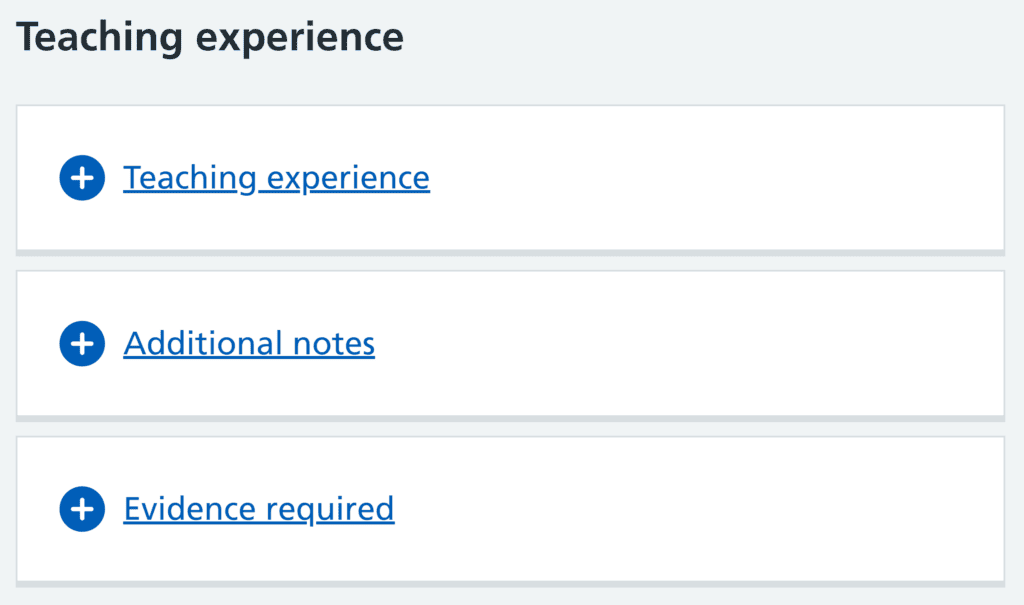
Expanding the “Training experience” tab describes the indicator to select when uploading your index page. It includes the following information as the last two entries on the table.
| For CST1: Teaching Experience Options | Indicator | Notes |
|---|---|---|
| . . . Or I have undertaken some educational activity focused on learning to teach | D | This would include any form of educational event focused on learning the skills of teaching – such as a training the trainers course online or otherwise |
| I have not provided teaching | E |
Information under the Evidence required” tab states:
“A certificate for the educational event focused on learning how to teach”
So, the certificate which you receive for completing any of our Teach the Teacher courses means you can select indicator D on the scale of A-E.
It’s important to note that your final grade for Teaching Experience will be determined by your assessor during interview. So, being able to confidently explain what you learned from your course and how you have used the skills and knowledge gaining will be essential for your success.
For CST1 programme applications, you can select indicator D for any of our Teach the Teacher courses, including 2-day tutor-led Teach the Teacher Course for Doctors, whether that is taken in our Virtual Classroom or In-person, our 3-day Extended Teach the Teacher Course, or our Teach the Teacher Online Course where you gain access to materials which you work through on your own or at your own pace.
Radiology Teaching and Training
Here’s an excerpt from the Domain 3: Teaching and Training e as it appears on the Clinical Radiology ST1 Portfolio review guidance webpage.
| Clinical Radiology ST1: Descriptor | Category |
|---|---|
| Hold a formal teaching qualification awarded at postgraduate level, for example: masters, CILT, PGDip, PG Cert | A |
| Have made a major contribution to a national or international teaching programme, with evidence | B |
| Evidence of other training in teaching methods after study of at least 2 days (such as Train the Trainers) | C |
| Have evidence of providing regional teaching | D |
| None of the above | E |
For Clinical Radiology ST1, you score category C for our tutor-led 2-day Teach the Teacher Course for Doctors, whether you taken in our Virtual Classroom, or in-person. Our 3-day Extended Teach the Teacher Course will provide you with a broader experience but the same scoring for Radiology applications.
Our instant-access Teach the Teacher Online Course is designed for you to work through alone and at your own pace. It does not involve a live tutor, and therefore cannot currently be used for Radiology ST1 applications.
Ophthalmology ST1, Education & Teaching
The Ophthalmology ST1 Evidence Folder for recruitment takes a different approach from other specialties in that it utilises cumulative scoring within domains. Here is a summary of the Education & Teaching domain from the Evidence Folder guidance.
| CUMULATIVE SCORING (max score 5pts) | Ophthalmology ST1 |
|---|---|
| 0.5 points each | – for helping with an educational course (more than one session), designing an e-learning tool, writing an e-book, completing a “teaching the teachers” course and/or undertaking a formal role in examining undergraduates. |
| 1 point | – for contributing to at least three teaching sessions on different subject areas over a period of at least 3 months with formal feedback uploaded. |
| 2 points | – for a Higher teaching qualification e.g. a Diploma, Certificate in Medical education. |
| 2 points | – for writing a chapter in a postgraduate-level academic book. |
| 3 points | – for writing a postgraduate-level academic book. |
Cumulative scoring for Opththalmology means that you can be recognised for 0.5 point for taking any of our Teach the Teacher courses PLUS additional points for any of the other criteria listed.
For Ophtalmology ST1 applications, you score 0.5 points for any of our Teach the Teacher courses, including 2-day tutor-led Teach the Teacher Course for Doctors, whether that is taken in our Virtual Classroom or In-person, our 3-day Extended Teach the Teacher Course, or our Teach the Teacher Online Course where you gain access to materials which you work through on your own or at your own pace.
Histopathology ST1, Training in Teaching
The Histopathology Training Self-Assessment scoring guidance for applicants webpage lists the following scoring criteria for the Training in Teaching domain.
| Histopathology ST1: Options | |
|---|---|
| I have had substantial training in teaching methods lasting more than 2 days; this could include a completed module which forms part of a postgraduate teaching qualification | 2 |
| I have had brief training in teaching methods lasting no more than 2 days | 1 |
| I have had no training in teaching methods | 0 |
For Histopathology ST1 applications, you score 1 for any of our Teach the Teacher courses, including 2-day tutor-led Teach the Teacher Course for Doctors, whether that is taken in our Virtual Classroom or In-person, or our Teach the Teacher Online Course where you gain access to materials which you work through on your own or at your own pace.
For Histopathology ST1 you score 2 points for our 3-day Extended Teach the Teacher Course, or if you complete both our 2-day Teach the Teacher Course for Doctors AND our Teach the Teacher Online Course.
Other points to consider
Completing the application is only the first hurdle in achieving your training post. If you are successful in getting through to interview then you have the challenge of presenting yourself at your best during the intensive interview process. So, you need to gain as much experience in numerous areas between now and then. You will need to demonstrate your patient communication, team communication and leadership skills. Taking courses in these subjects will give you fresh input and help you to clarify your thinking. Being able to show that you have put ideas gained from course theory will always improve your chances of success.
And it’s always worth considering a dedicated interview preparation course to help you pull everything together.
We’ve got more advice on our CST & IMT Interview Free Advice webpage.
All the best with your application and continue to develop your abilities to maximise your potential.
Stephen McGuire – Managing Director
